
Wildebeest migration from space is something satellites can now capture and count. Commercial satellites orbiting 617 to 770 km above the Earth photograph the plains sharply enough that each animal shows up as a few dark pixels, and AI models tally them. A 2025 study in PNAS Nexus used this approach. It counted fewer than 600,000 wildebeest in the dry-season range, far below the 1.3 million figure quoted since the 1970s.
The result surprised scientists, and it matters to anyone who plans a trip around the herds. We are a Nairobi-based safari operator, in business since 1986, and we run a private campsite in the Masai Mara. This article looks at the same herds from orbit.
Below you will find why counting from space matters, how the satellite and AI method works, what the numbers say about herd size, where the method falls short, and how to see the real thing in Kenya.
Why counting wildebeest from space matters
You cannot protect what you cannot count. Park managers, researchers and tour operators all rely on herd numbers, and the traditional counting method has real blind spots.
Where aerial surveys fall short
For decades, counts came from crewed aircraft that photograph fixed strips of land called transects. Scientists then extrapolate those strips into a total for the whole ecosystem. That works until herds move between strips or bunch up unevenly, and then the error can be large.
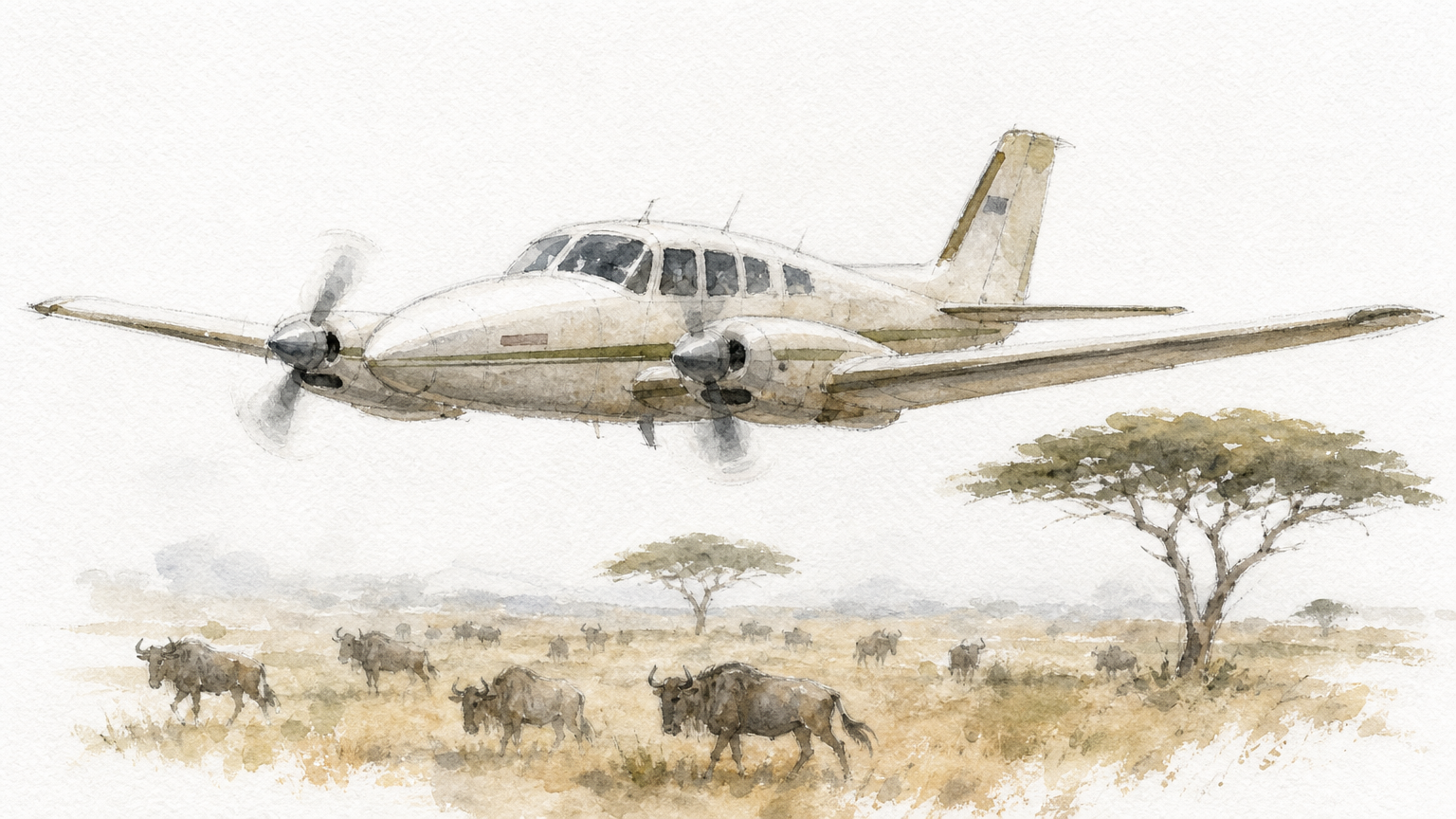
A satellite does not have to guess what lies between survey lines. It captures a vast area at a single moment, and no aircraft disturbs the animals below.
A satellite photographs the whole landscape at once, so it never has to guess what lies between survey lines.
Why the total matters for conservation
Lead researcher Dr. Isla Duporge states the case plainly: wildlife conservation depends on accurate population data. The pressures on the herds are growing. Expanding farmland, infrastructure and fencing break up migration corridors, and shifting rainfall changes where the grass grows.
The herds also feed lions, hyenas and crocodiles, and they bring tourism revenue to both Kenya and Tanzania. A wrong baseline affects every one of those decisions.
How satellites and AI count the herds
Counting from orbit takes three things: very sharp imagery, a trained computer model, and a check against ground data. Each step has its own job.
What a wildebeest looks like from orbit
The images in the 2025 study had a resolution of 33 to 60 cm per pixel. At that scale each wildebeest is fewer than nine pixels, a small dark smudge. No person could count hundreds of thousands of smudges by hand.
Dense columns are easier to spot. Densities of up to 1,000 animals per square kilometer have been reported along the route, which is why the moving lines of wildebeest can show up as dark streaks on the plains.
The counting process step by step
The Oxford-led team worked in five steps:
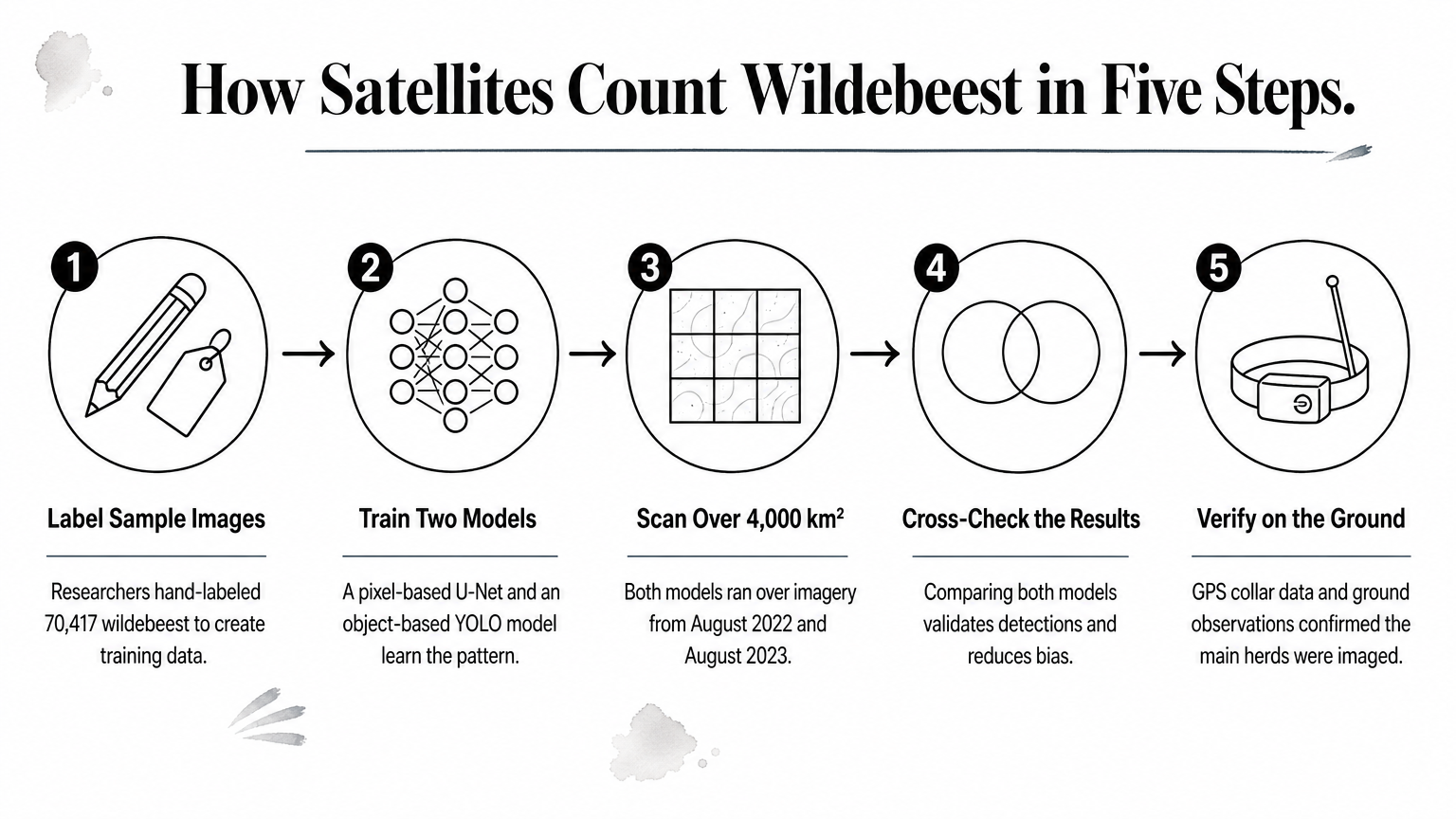
- They manually labeled 70,417 wildebeest in sample images to create training data.
- They trained two deep learning models: a pixel-based U-Net and an object-based YOLO model.
- They ran both models over more than 4,000 km² of imagery taken in August 2022 and August 2023.
- They compared the two sets of results to cross-validate the detections and reduce bias.
- They checked the imaged area against GPS collar data and ground observations, to confirm the main herds were inside the pictures.
At satellite scale a wildebeest is a handful of pixels, so counting depends on software, not eyesight.
What the satellite counts reveal about herd size
The headline result is a dry-season herd below 600,000, well under the long-quoted 1.3 million. The two survey years also differed sharply from each other.
The numbers side by side
| Count | Estimate |
|---|---|
| Figure widely cited since the 1970s | About 1.3 million |
| Other figures in print | Roughly 1.2 to 1.5 million |
| Satellite count, August 2022 | 324,202 to 337,926 |
| Satellite count, August 2023 | 502,917 to 533,137 |
Even the higher 2023 range sits hundreds of thousands below the old figure. The spread of published numbers also shows how loosely the "million" has been used.
What the gap does and does not mean
It does not prove a collapse. The researchers say changes in migration routes or survey coverage could explain the difference, and they caution against reading it as a decline. Some animals hide under trees, but it is unlikely that trees hid hundreds of thousands.
The jump from about 330,000 in 2022 to roughly 500,000 to 530,000 in 2023 shows why one snapshot is not a trend. Timing matters too. Smaller herds appeared earlier in August, and the count covers only the dry-season range.
The satellite count is a new baseline to build on, not proof that the herds have shrunk.
Limits of satellite counting and what comes next
Satellite counting is a strong new tool, not a replacement for aircraft or fieldwork. Its limits are clear, and so is the plan for improving it.
Where satellite counts fall short
Several constraints apply:
- Images are expensive to buy.
- Cloud cover can block the view.
- Animals under trees or outside the frame are missed, although aerial surveys miss animals too.
- The 2025 study covers the dry-season range only, not the full annual cycle.
Next steps for the technique
The researchers want aerial and satellite surveys run in parallel, so each method can correct the other. As more satellites capable of imaging at under 50 cm launch, a single spot can be revisited several times a day, which brings monitoring closer to real time.
The method may also suit other herd animals, including zebra, reindeer and camels, and researchers are adapting it to count rhinos. It builds on earlier work that tracked elephants from space.
Satellites and aircraft work best as partners, each checking the other’s blind spots.
How to see the migration from the ground in Kenya
Satellites show you the scale, but the Mara River crossings are best watched from a vehicle on the riverbank. The herds follow the rains, so any calendar is a guideline, not a promise.
Timing and where to look
The usual pattern runs as follows:
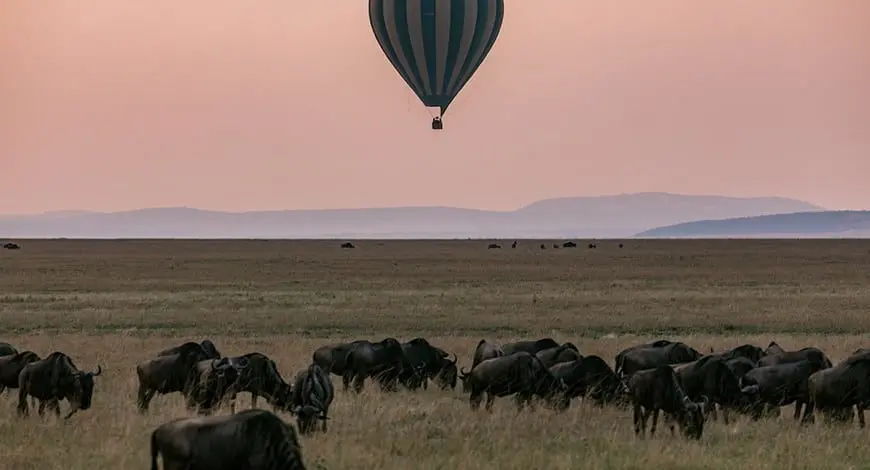
- Mara River crossings in Kenya: typically late July to early September.
- Calving in the southern Serengeti, Tanzania: late December to mid-March.
- The circuit: the herds loop clockwise through the Serengeti and the Mara and return south near the end of the year, each animal covering 800 to 1,000 km.
Rains have become less predictable, so allow several days in the Mara rather than one.
Our own private camp on the Talek River is a comfortable base for this. It has six en-suite tents with hot showers, home-style meals and evening campfires with Maasai guards, and you can read more on the camp page. If you prefer a lodge or tented camp, our BCL 3A itinerary includes a full day along the Mara River looking for crossings, with a picnic lunch at the Hippo Pool. Our 6 Days Masai Mara Wildebeest Migration Special adds a Masai village visit and a balloon safari on day three.
More of Kenya beyond the herds
The migration is one chapter of a Kenya safari. Amboseli puts elephants in front of Mount Kilimanjaro, Lake Nakuru and Lake Naivasha are rich in birdlife, and Samburu offers dry-country species such as Grevy’s zebra and gerenuk that you will not see in the Mara.
After the bush, the Indian Ocean coast offers snorkeling, scuba diving, dolphin and whale watching, day excursions and a strong food culture. We can arrange beach stays in Diani, Watamu, Mombasa, Malindi and Lamu, plus Zanzibar.
Plan the trip around the whole of Kenya, and treat the herds as the highlight rather than the only reason to go.
Seeing the herds up close
Satellites have given us a new way to count the migration, and the first results suggest the old 1.3 million figure needs a second look. They do not say the herds are vanishing, and they do not replace the experience of standing beside a river crossing. The best plan combines the science with a few days in the field.
If you want help matching your dates to the herds and the rest of Kenya, contact us for a current quote. Rates change, so we price each safari when you ask.
To plan your safari, call or WhatsApp on +254 723 166170, call +254 733 630053, email reservations@bestcampingkenya.com or visit bestcampingkenya.com.