
A camping safari is a wildlife trip where you sleep in a tent in or beside a national park or reserve instead of a permanent lodge room. The tent can be a basic dome you pitch yourself or a roomy en-suite safari tent with a real bed. Either way, you spend your nights with the sounds, the cold air and the stars of the bush. For many travelers it is also the more affordable way to spend several days with the animals.
A camping safari in Africa comes in many forms, so this guide uses Kenya as the main example, with Tanzania as a natural extension. You will learn what safari camping involves, how the camping styles differ and how to choose one. You will also see which Kenyan parks suit camping and what each offers, how the seasons change the trip, and the honest pros and cons.
Best Camping Tours & Safaris has run camping safaris from Nairobi since 1986. We use our own vehicles and run a private camp on the Talek River in the Maasai Mara. What follows comes from nearly four decades of putting guests in tents, and from watching what they enjoy and what they would change.
Why a camping safari is worth considering
A camping safari is worth it when you want to be inside the wildlife experience instead of retreating from it at dusk. You hear the animals, smell the woodsmoke and feel the early chill, and you usually spend less on accommodation than at a lodge. The trade is comfort, and how much you give up is your choice.
What you gain by sleeping in the bush
Start with the nights. Safari camping puts you under a sky with no city glow, with hyenas whooping and hippos grunting somewhere beyond the firelight. Lodge guests hear the same sounds through a wall and a closed window.
Mornings matter just as much. You unzip the tent at first light, drink tea by the fire and are in the vehicle while the big cats are still active and the air is cool. A camp in or beside the reserve also cuts the transfer time at each end of the day. Where flight times allow, you can start a game drive on the day you arrive.
Camping trades a little comfort for closeness and time in the park, especially at dawn and dusk when animals move.
What you give up
Be honest about the downsides. Facilities are simpler than in a lodge, and electricity is limited, so charge batteries whenever you can. Nights can feel properly cold at altitude, and the Maasai Mara in July and August is a good example. Rain turns tracks and campsites muddy.
Dust, insects and early starts are part of the deal. Some styles also ask you to pitch your tent and help with camp chores. If you need air conditioning, a pool and a late breakfast to enjoy a holiday, choose lodges.
Camping safari or lodge safari?
The two styles differ less in what you see than in how you live around it.
| Camping safari | Lodge safari | |
|---|---|---|
| Closeness to wildlife | Sounds, smells and night sky at your tent door | Sounds muffled by walls, though some lodges sit close to the action |
| Comfort | Simple to comfortable, depending on the style | Full rooms, often with a pool and bar |
| Accommodation cost | Generally lower | Generally higher |
| Weather | You feel the cold, rain and dust | Sheltered |
| Evenings | Campfire and early bed | More amenities and a later pace |
| Chores | None to some, depending on the style | None |
Couples, families with older children, photographers and friends traveling together tend to enjoy camping most. Older travelers do well too when the camp has proper beds and private bathrooms. Travelers who want a room with all the services should pick lodges, or mix the two in one trip.
How to choose your camping safari style
Choose by comfort first and effort second. Decide whether you want a real bed and a private bathroom, or whether pitching your own tent is part of the fun, and the style follows from that answer.
The camping styles compared
Four styles cover most of what you will find in East Africa. Park authorities also run public campsites and exclusive-use special campsites, which operators use for group trips.
| Style | Where you sleep | Effort from you | Best for |
|---|---|---|---|
| Private camp with en-suite tents | Fixed camp, raised bed, own shower and flush toilet | None | Couples, families, first-timers |
| Participation camping | Dome tent you pitch, sleeping mat, shared facilities | Pitch the tent, help with cooking and washing up | Budget travelers, adventurers |
| Mobile camping | Light tents moved every few days to new sites | Varies by operator | Travelers who want remote sites and variety |
| Luxury tented camp | Large permanent tent with a full bathroom | None | Comfort seekers who still want canvas |
The labels blur, so ask exactly what you will sleep on and who does the work. A "tented camp" can mean anything from a mat on the ground to a suite with a chandelier.
The label matters less than three facts: what you sleep on, where you wash, and who pitches the tent.
What comfortable camping looks like in the Mara
Our private Mara camp sits on the banks of the Talek River in the Maasai Mara. It has six en-suite tents and a family tent. Each has a proper bed with clean linen, blankets and pillows, a private shower with hot water, a flush toilet and an individual solar light kit. You can see the setting in our campsite video.
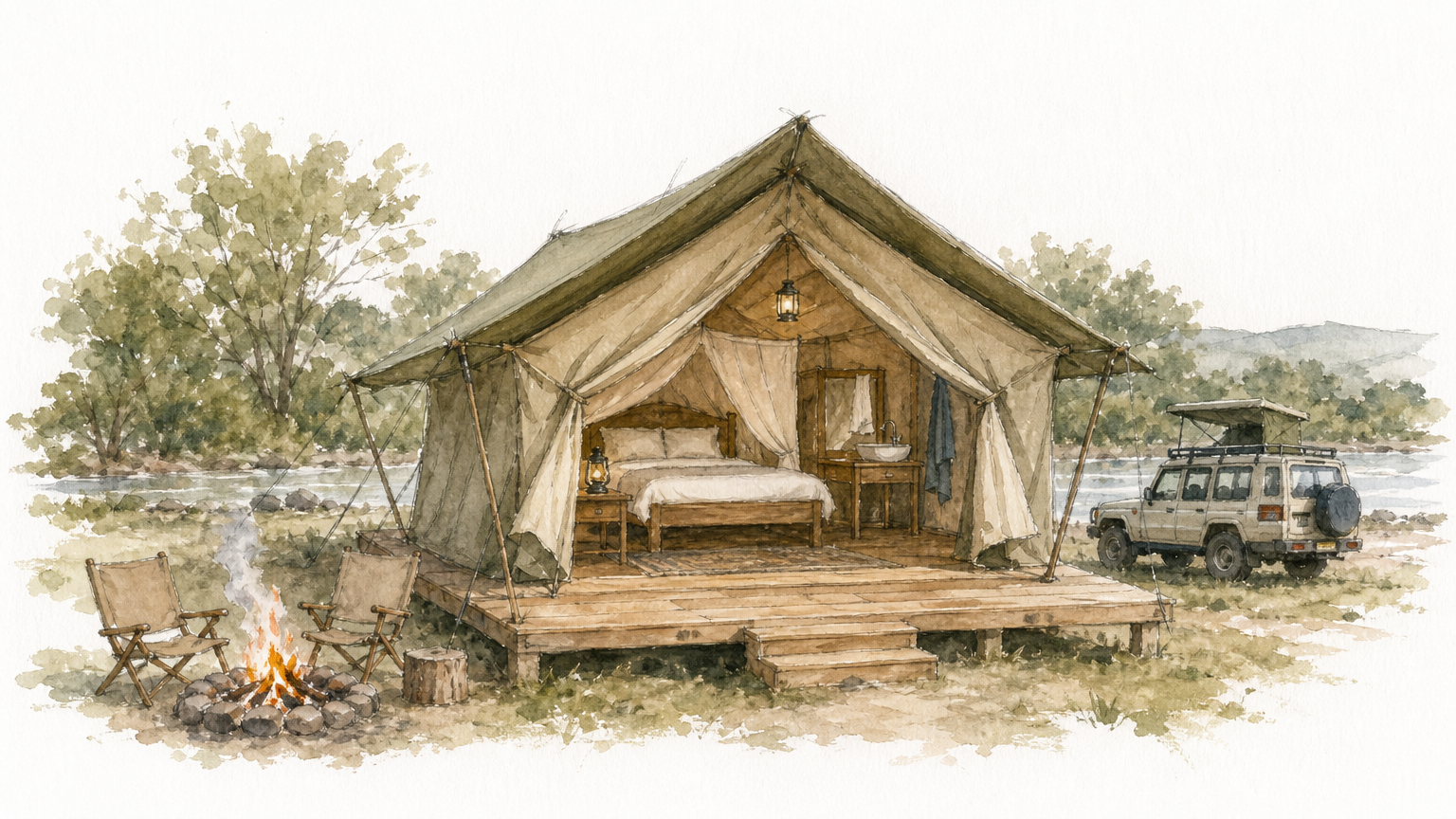
Meals are freshly prepared each day by the camp team, and local Maasai guards look after the camp. Evenings end around the campfire, where the guards share stories and traditions. Guests can also visit nearby Maasai villages, local towns and schools.
We run these stays as private safaris. It is only you and your family with your driver-guide, in a Land Cruiser with a pop-up roof and sliding windows and a maximum of six guests per vehicle. Our 3 day (BCTS 1) and 4 day (BCTS 3A) Mara itineraries use this camp. We also offer a 4 Days Masai Mara Camping Bestseller.
Mixing camping with lodges
Many travelers prefer a blend. Our 6 day itinerary covers the Maasai Mara, Lake Nakuru and Amboseli, with accommodation arranged as a luxury lodge, luxury tented camp, campsite or hotel as the route suggests. You camp where camping adds the most, such as the Mara. You sleep indoors where you want a pool or a morning view of Mount Kilimanjaro.
Where and when to go on a camping safari in Kenya
Kenya’s parks differ so much that the best place to camp depends on which animals and birds you want most. The best time depends on whether you prefer dry-season game viewing or the quiet, green months. Treat the parks as separate experiences rather than interchangeable stops.
Kenya’s parks compared
| Park or reserve | Signature wildlife | Birds and notes |
|---|---|---|
| Maasai Mara | Lion, cheetah, leopard, elephant, buffalo, rhino, hippo, giraffe, zebra, topi, hyena, plus the wildebeest migration | Secretarybird, ground hornbill, lilac-breasted roller |
| Amboseli | Large elephant herds, buffalo, giraffe, zebra, hippo, lion | Wetland birds and kori bustards, with Kilimanjaro as the backdrop |
| Lake Nakuru | White and black rhino, Rothschild’s giraffe, buffalo, leopard | Flamingos (numbers vary through the year) and pelicans |
| Samburu, Buffalo Springs, Shaba | The Special Five: Grevy’s zebra, reticulated giraffe, Somali ostrich, beisa oryx, gerenuk; also elephant, lion, leopard | Vulturine guineafowl, golden-breasted starling, dry-country raptors |
| Tsavo West | Elephants, lion, hippo and crocodile at Mzima Springs | Varied dry-country birds across a very large park |
| Lake Naivasha | Hippo, giraffe, buffalo | Fish eagles and many waterbirds, with boat trips on the lake |
Pick the Mara for big cats and open plains. Pick Amboseli for elephants against Kilimanjaro, Samburu for species you will not see elsewhere, and Nakuru for rhinos and flamingos. Most travelers combine two or three.
Tanzania as a camping extension
If you want more time, Tanzania adds the Serengeti, Ngorongoro Crater, Lake Manyara and Tarangire. Our camping itineraries run 7 days (Manyara, Serengeti, Ngorongoro and Tarangire), 12 days and 13 days. The longer ones start in Kenya and cross at Namanga. They link the Mara, Nakuru and Amboseli with the Tanzanian parks.
Seasons and the Kenyan year
Kenya has a camping season for almost every month, so you do not need to plan around one event.
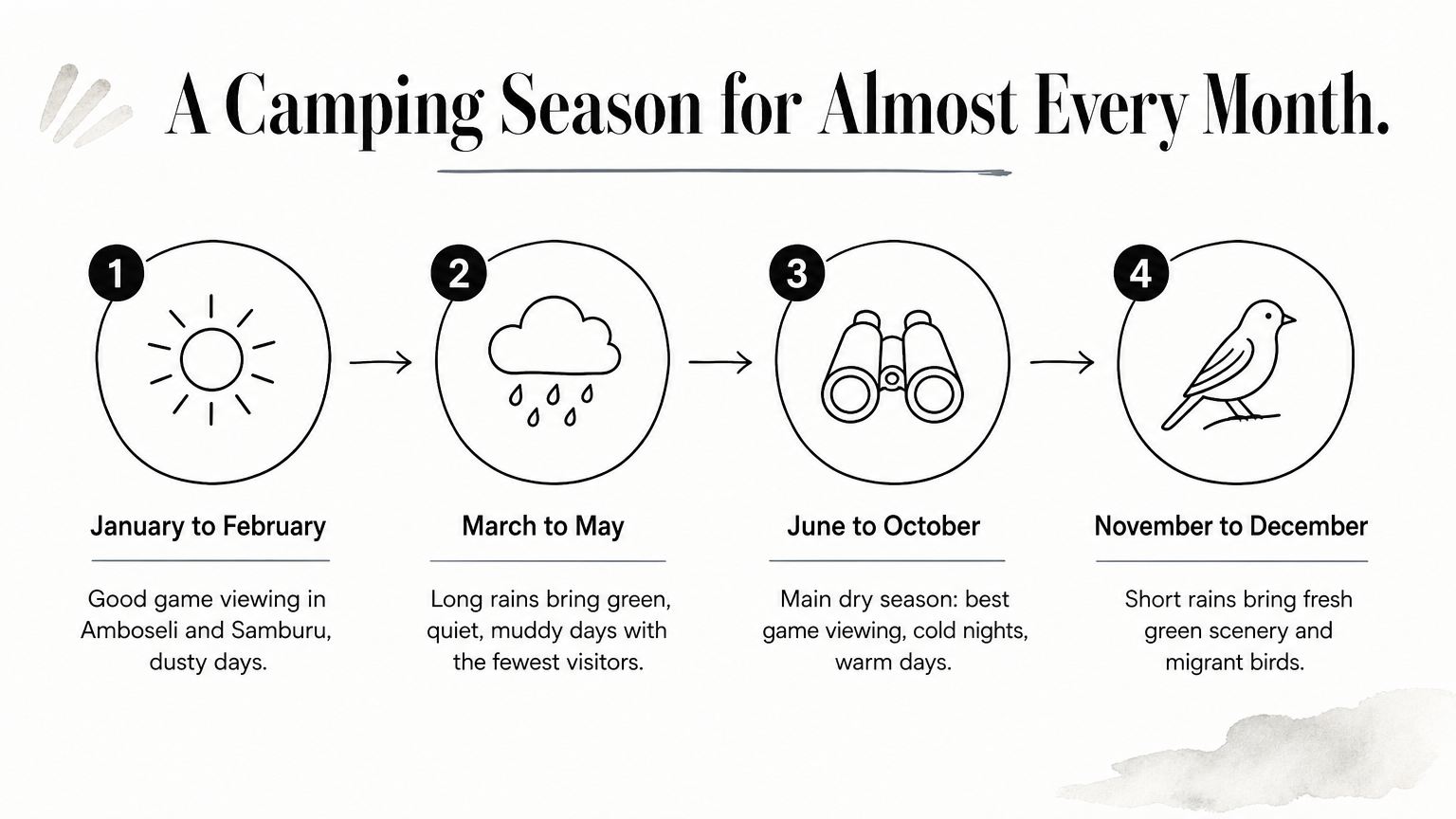
| Period | Conditions | Camping notes |
|---|---|---|
| January to February | Hot and mostly dry | Good game viewing in Amboseli and Samburu, dusty days |
| March to May | Long rains | Green, quiet and muddy, with the fewest visitors, so pack waterproofs |
| June to October | Main dry season | Best game viewing, cold nights and warm days, busiest months |
| November to December | Short rains | Fresh green scenery and migrant birds, with showers that are often brief |
For the Mara, our own advice is the dry period from June to October. The migration’s Mara River crossings fall in that window. But the Mara is rewarding in every month, and the migration is only one chapter of Kenya.
The coast adds a second chapter. After the bush you can add beach days, snorkeling and scuba diving, dolphin watching, seasonal whale watching, night life and Swahili food in places like Diani, Watamu, Mombasa, Malindi, Lamu or Zanzibar.
Pick the park for the animals you want, then choose the month for the weather you can enjoy in a tent.
How to prepare, stay safe, and book with confidence
Pack for cold nights and strong sun, follow your guide’s rules after dark, and book only after you have asked the operator what the camping style, vehicle and group size really are. A little preparation separates a trip you love from one you endure.
What to pack
Bring layers and neutral colors, and leave the rest to your operator:
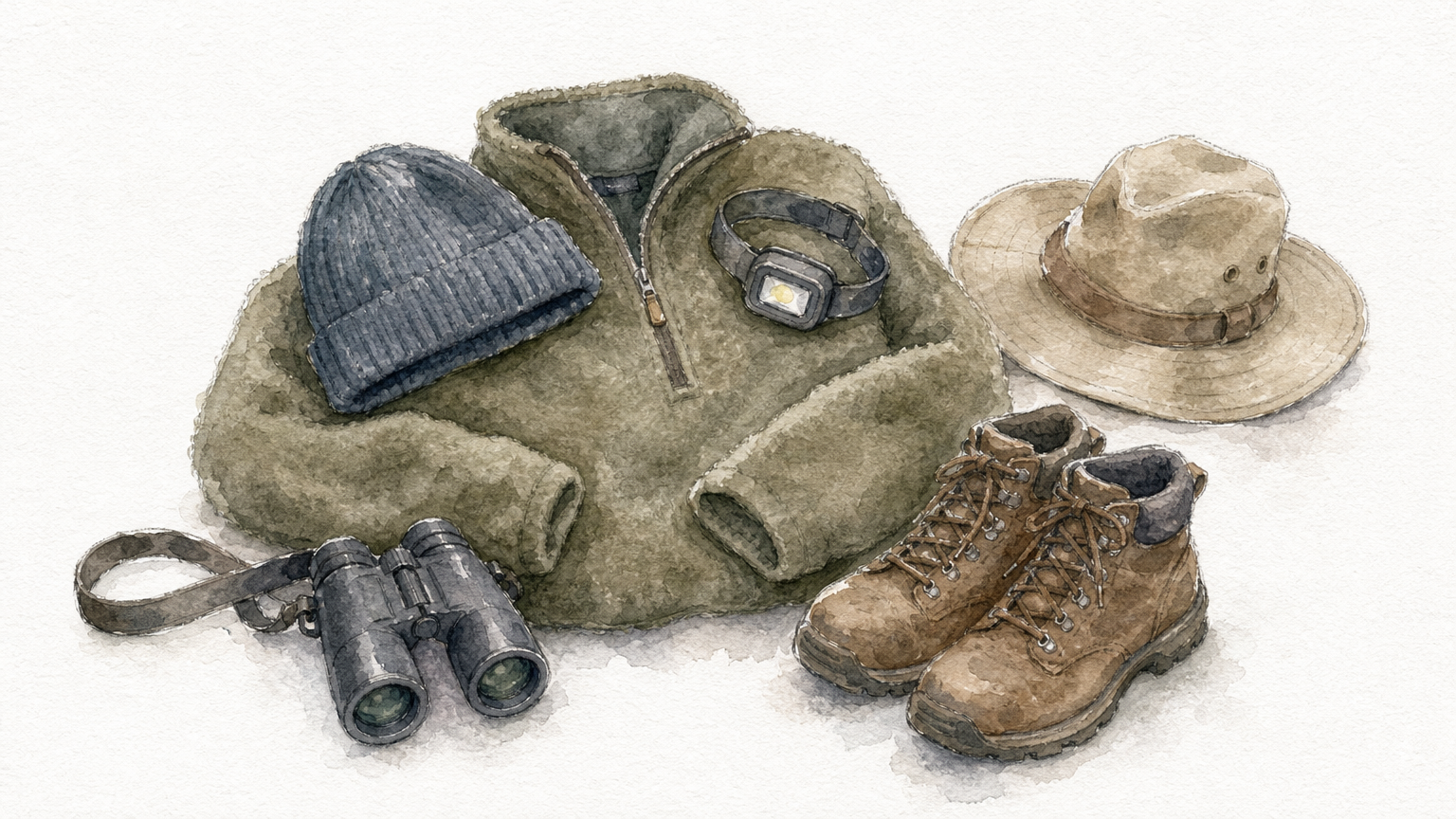
- A warm fleece and a beanie for nights and early game drives.
- Light, neutral clothing in khaki, olive or tan, and long sleeves for the evening.
- A sun hat, sunglasses and high-factor sunscreen.
- Sturdy closed shoes and a headlamp.
- Insect repellent, binoculars and a power bank.
- Your regular medications, plus a basic first-aid kit.
Neutral colors hide dust, and dark blue and black can attract tsetse flies in some areas. Red and white are not dangerous, though white shows dust fast. Leave camouflage prints at home, because civilians face restrictions on them in Kenya and Tanzania.
Staying safe in a wild camp
Listen to your guides. They give a safety briefing at camp and know how each site behaves after dark. Typical rules are to stay in or near your tent at night, use your torch and walk with a guard if you need the bathroom.
Keep tents zipped, keep food out of them, and bring shoes inside so hyenas cannot carry them off. Animals sometimes walk through camps at night, but they generally keep away from people and tents.
Questions to ask before you book
A good operator answers these without hesitation:
- Is the camp fixed or mobile, and is it private or shared with other groups?
- Do I sleep on a bed or a mat, and is the bathroom private?
- Will I pitch my own tent or help with chores?
- Is the safari private, and what is the maximum number per vehicle?
- Does the operator run its own vehicles, and is it licensed?
- What are the current rates? Rates change with fuel costs, so ask for a current quote.
Best Camping Tours & Safaris is licensed by the Tourism Regulatory Authority and affiliated with the Kenya Association of Tour Operators.
Optional extras to budget for
Some experiences cost extra on top of your safari. These figures are the ones listed on our itineraries.
| Extra | Cost |
|---|---|
| Hot air balloon safari over the Mara | US$475 per person on some itineraries, US$550 including bush breakfast on others |
| Maasai village visit | USD 20 to 25 per person, depending on the itinerary |
| Olduvai Gorge stop (Tanzania) | $36 per person |
| Tanzania visa at the Namanga border | $50 to $100, so confirm before you travel |
Read independent reviews before you commit
Guest reviews show what a brochure cannot. Read our traveler reviews on TripAdvisor and look for patterns about guides, camp comfort and how quickly the team answers. You can also find us on Google Reviews and in travel guides such as Lonely Planet and Le Routard.
Choosing your camping safari
A camping safari puts you close to wildlife in a way a lodge room cannot, at the cost of some comfort. Start with how much comfort you want, from a pitched dome tent to an en-suite tent with a hot shower. Then pick the parks for the animals and birds you most want to see, and a season that suits your tolerance for cold, dust or rain. Kenya’s parks differ so much that two trips can feel like different countries, and Tanzania adds more if you have the days.
If you would like help matching a style, park and month to your group, ask us for a current quote. We will build the safari around your interests and budget.
To plan your trip, call or WhatsApp on +254 723 166170, call +254 733 630053, email reservations@bestcampingkenya.com, or visit bestcampingkenya.com.