
The Great Migration is the year-round, Clockwise movement of well over a million wildebeest, along with hundreds of thousands of zebra and gazelle, around the Serengeti-Mara ecosystem in Tanzania and Kenya. When is the Great Migration in Africa? There is no single date, but the pattern is dependable. Calving happens on the southern Serengeti plains from January to March. The herds trek north from April to June. Mara River crossings run from July to October. The animals return south from late October through December.
This guide covers why the timing matters, where the herds are in each season, and how the route runs from Tanzania into Kenya. It also shows you how to pick the right month for what you want to see, and how to plan for animals that ignore calendars.
Our Nairobi team at Best Camping Tours and Safaris has run Kenya safaris since 1986, including camping safaris in the Masai Mara. The advice below is practical, and it is honest about what nobody can promise.
Why the timing of the Great Migration matters
Timing matters because the herds follow rain and fresh grass, not a calendar. The month you travel decides what you see, where you need to stay and how crowded the plains are.
What the Great Migration is
The Great Migration is a continuous loop, not a single event. Estimates put the number of wildebeest between 1.4 and 2 million, and they travel with zebra, Thomson’s and Grant’s gazelle and eland. Lions, hyenas and crocodiles follow the herds and shape every stage of the journey.
Many travelers picture one scene: wildebeest bunched on a riverbank, then pouring into the water. That scene is real, but it fills only a few weeks of a circuit that lasts all year. Calving, rutting and long marches across open plains are just as much a part of it.
Why the herds keep moving
Grass and water drive everything. The short-grass plains of the southern Serengeti turn green in the wet season, and the volcanic soil makes that grass rich in minerals. Predators are easy to spot on open ground, so the plains are a relatively safe place to calve.
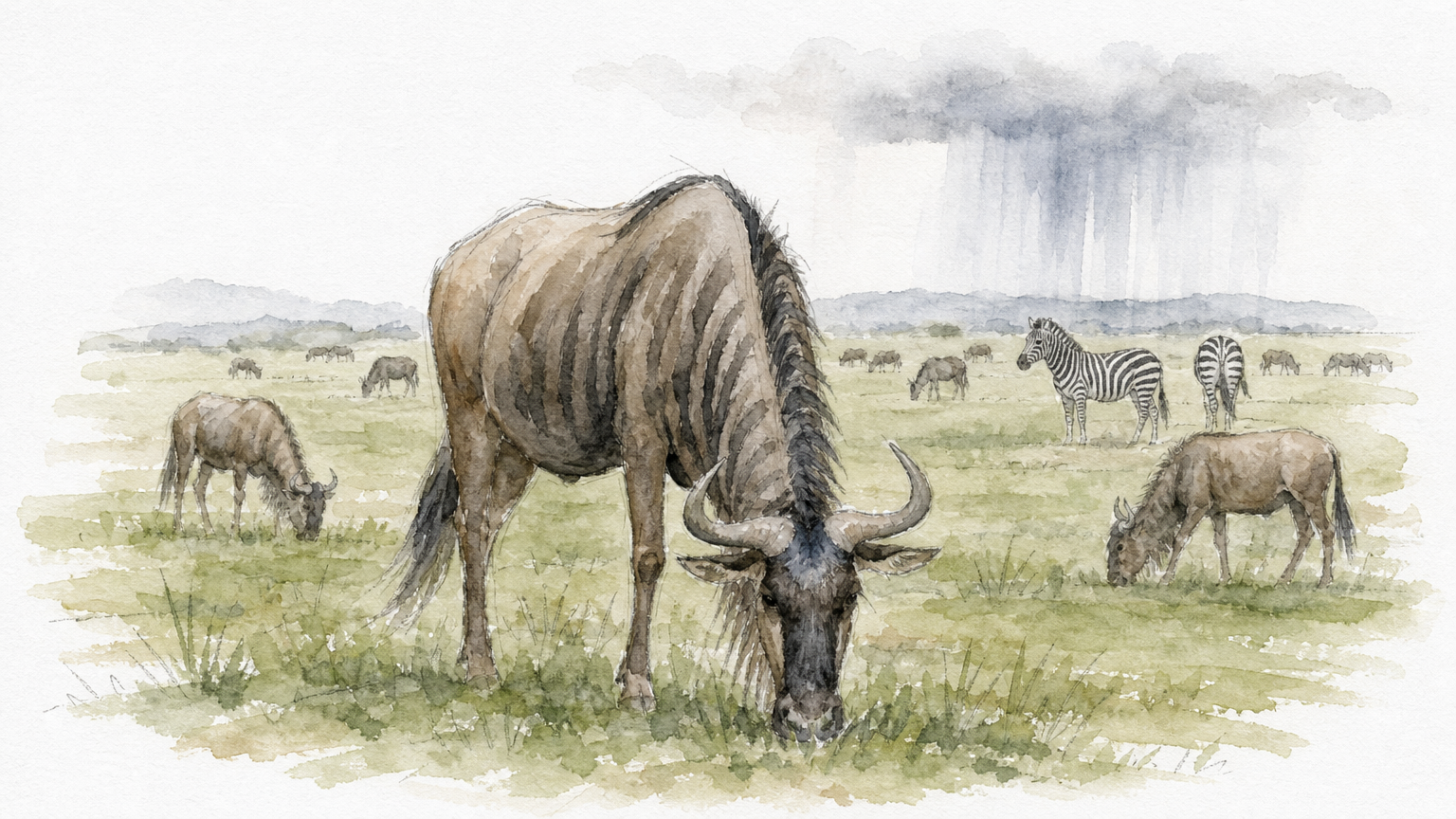
When the plains dry out, the herds move west and north. The far north gets the most rain, but its grasses are less nutritious. The Mara River is the ecosystem’s only dependable permanent water, so the dry-season retreat ends there until the short rains pull the animals south again.
The herds follow rain, so the calendar gives you a pattern, never a promise.
What your travel month changes
Your month decides whether you meet newborn calves, a river crossing or quiet northern plains. It also decides price and crowds. July to September is peak season on both sides of the border, and the best camps fill many months ahead.
How to follow the herds month by month
Think in four seasons. The herds calve in the south from December to March and trek north from April to June. They cross the northern rivers from July to October, then head back south from late October.
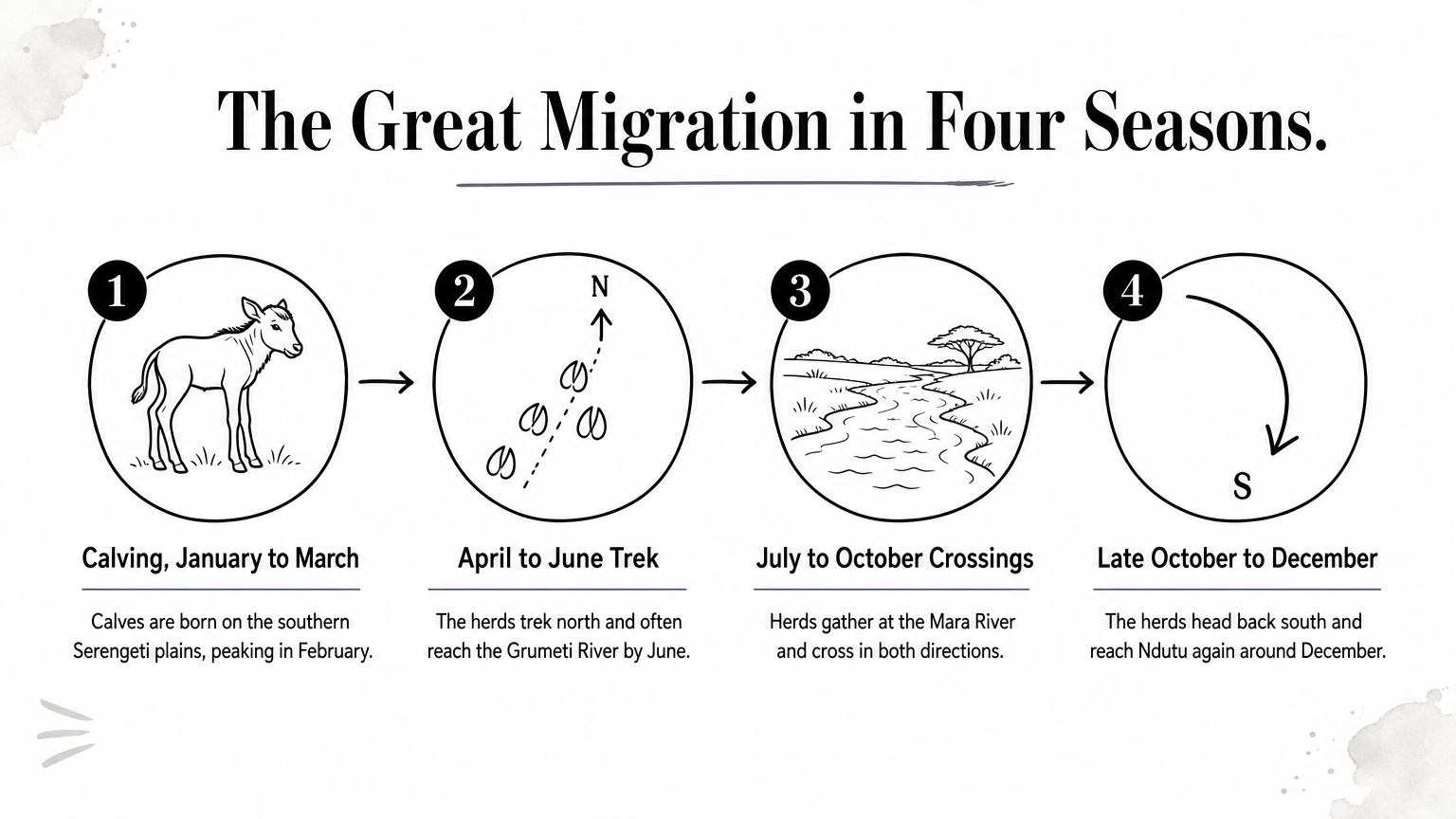
The year at a glance
| Months | Where the herds are | What you see |
|---|---|---|
| December to March | Southern Serengeti plains, Ndutu, northern Ngorongoro Conservation Area | Calving, peaking in February, with heavy predator activity |
| April to May | Central Serengeti, Moru Kopjes, moving north | Long columns on the march, rut begins |
| June | Western Corridor and the Grumeti River | Peak rut, herds massing at the first river |
| July to September | Northern Serengeti (Kogatende) and the Masai Mara | Mara River crossings, in both directions |
| October to November | Mara River re-crossings, Lobo area, central Serengeti | Herds heading south, fewer vehicles |
Treat every row as a window that can shift by several weeks either way.
December to June: calving, trek and rut
Most of the roughly 500,000 calves arrive within a few weeks between late January and mid-March, with February as the peak around Ndutu. A calf stands within minutes of birth and soon runs with the herd. That sheer number of vulnerable young draws lions, hyenas and cheetahs.
From April the plains dry and the herds drift north through the Moru Kopjes in columns that can stretch for kilometers. The males fight for mates during the rut. By June the front of the migration often reaches the Grumeti River in the Western Corridor, where the animals may wait on the south bank for up to two weeks before crossing.
July to November: crossings and the return
By July the leading herds reach the northern Serengeti and the Mara River. In a dry year the first animals can arrive in early July, and in a wet year it may be mid-August. August and September bring the bulk of the herds into the Masai Mara, with animals crossing back and forth.
In October the herds cross the Mara again, heading south. They move through the quiet Lobo area in October and November and reach the Ndutu plains again around December, where the cycle restarts.
The famous crossings fill only a few weeks of a loop that never stops.
Where the Great Migration starts and where it crosses
For practical purposes the loop starts on the southern Serengeti calving plains in Tanzania, around Ndutu and the northern Ngorongoro Conservation Area. It then swings clockwise through the Western Corridor and northern Serengeti into Kenya’s Masai Mara, and returns south.
The Tanzanian half
Tanzania holds the calving grounds, the Moru Kopjes, the Grumeti River and the northern Serengeti around Kogatende. It also holds the Lobo area on the return leg. The herds spend most of the year inside the Serengeti.
Seronera in the central Serengeti is a useful landmark. The herds pass near it on the way back south, and the park’s main visitor center is there.
The Kenyan half
The Masai Mara is the northern end of the same ecosystem, and the border is invisible to the animals. The Mara River is the main crossing point, and the Talek River is another waterway running through the reserve. The Mara side is strongest from roughly July to October.
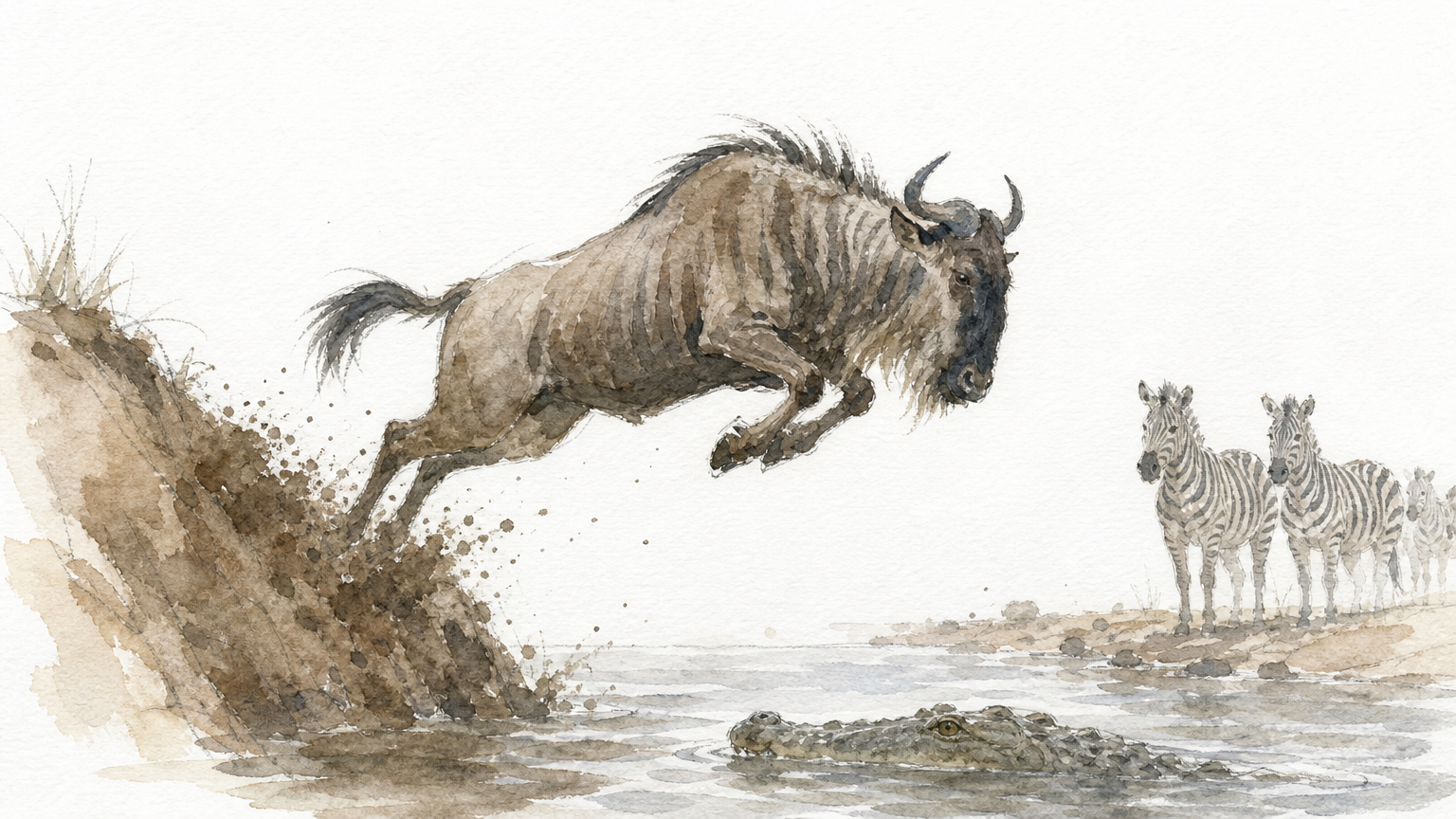
Our own tented camp sits on the banks of the Talek River in the Masai Mara. We can never promise a crossing on a given day.
Not every animal follows the map
The tidy circle on brochure maps is a simplification. Some herds go through the Western Corridor, while others go via Seronera, Lobo or the Loliondo area. A large share stays on the Tanzanian side all year, and some cross and re-cross the border for weeks.
Use the map as a guide to regions, and expect the herds to wander within them.
How to choose the best month for your safari
Choose your month by the scene you most want to see, then check crowds and budget. No single month is best for everyone.
Match the month to the sight
- Newborn calves and predator action: late January to March, southern Serengeti.
- Long columns and the rut: May and June, central and Western Serengeti.
- Mara River crossings: July to September, northern Serengeti and the Masai Mara.
- Quieter migration viewing: October and November, northern plains and the Lobo area.
- Fewer other visitors: January to March, when the southern plains are lush but quieter than the northern crossing points.
Book early and weigh the crowds
July to September is the busiest period, so book the best camps up to a year or more ahead. Operators commonly recommend 12 to 18 months for peak dates. October is a shoulder month with fewer vehicles, and many camps lower their rates once peak season passes.
If your heart is set on the Mara side, Best Camping’s 3 Days Wildebeest Migration budget camping safari in the Masai Mara is a short, affordable way in. A shorter trip gives you fewer chances to catch a crossing, so a longer stay improves your odds.
For general game viewing beyond the migration, the dry months from July to October are strong because animals gather near water.
How to plan around a migration that keeps no schedule
Plan around regions and seasons, not exact dates, and give yourself several days in the right area. Even in a month that suits you, the herds decide where they are.
How far the dates can shift
Rain moves everything. In November 2013 the herds had started south when rain fell north of the Mara River, and they turned back into the Masai Mara for about three weeks. In 2014 unusual rain in the southern Serengeti kept much of the herd on the plains until July.
Crossings carry the same uncertainty. A herd may gather at a river and mill around for days before it crosses, or it may turn away. Any operator who guarantees a crossing on a given day is overpromising.
Ways to improve your odds
- Choose a region and a season. Aim for the area the herds usually occupy in your month, not a single date.
- Stay at least three or four nights. More days in the right area means more chances to catch the movement.
- Use experienced driver guides. Guides who work the area daily know where the herds are shifting.
- Keep the plan flexible. Be ready to move if a herd moves.
- Value the resident wildlife. Lions, elephants and giraffes live in the Mara and Serengeti all year.
Is it worth planning a trip around the migration? Yes, because even without a crossing you will see thousands of animals on the move.
Give the herds time, and you give yourself the best chance of a memorable day.
When to go, in short
The Great Migration happens all year, and its best-known moments follow the rains. Calving peaks in February in the south, the herds trek north from April to June, and crossings and the Masai Mara season run from July to October. The herds head back south from late October.
Choose a month by what you want to see, book early for July to September, and stay long enough to give the herds a chance to show up.
If you want help matching your dates to the herds, speak with our Nairobi safari team and tell us what you hope to see.